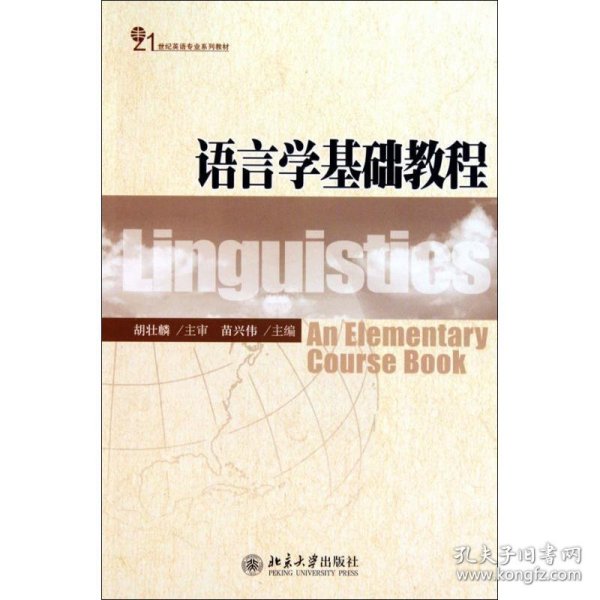
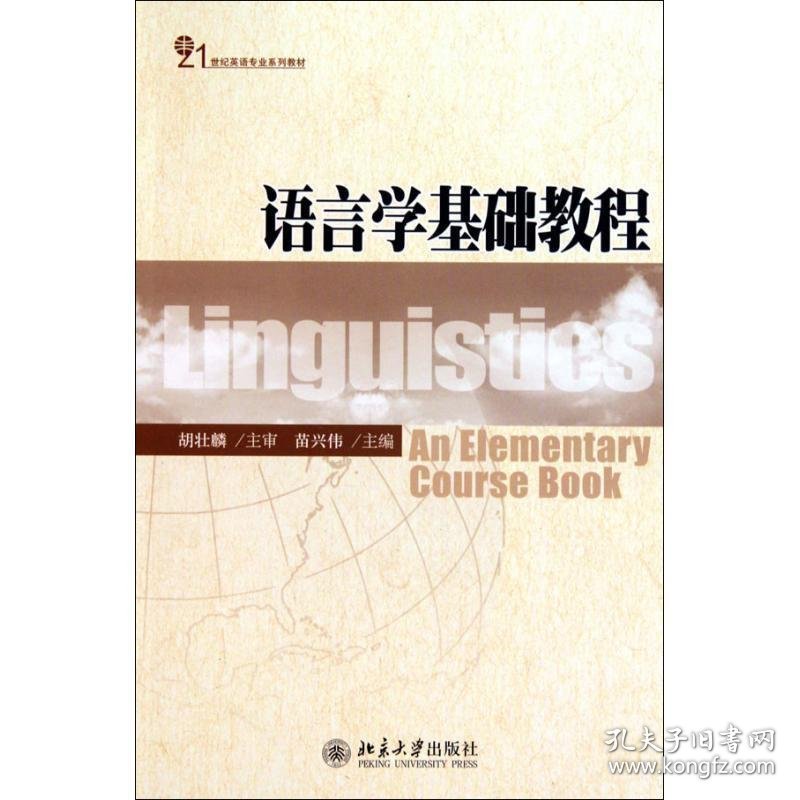
基本信息 书名:语言学基础教程 定价:32.00元 作者:侠名 出版社:北京大学出版社 出版日期:2010-07-01 ISBN:9787301138397 字数:249000 页码:238 版次:1 装帧:平装 开本:16开 商品重量: 编辑推荐 本教材的使用者主要为全国各高校英语专业的本科生。在内容方面,体现本科阶段课堂教学的特点,在提供基本知识的同时,更注重教材的科学性、系统性、实用性和时代性。在编写过程中,我们力求“化难为简”,尽量做到概念清晰,既要保证知识的系统性,又要避免术语的堆砌。本教材在传授基本知识与概念的同时,通过丰富的实例提供了有关语言分析和描述的基本方法,同时强调语言学与其他学科的联系,以便适应创新型人才培养的需要。为使学生巩固所学知识并进一步学习有关知识,每一章后都有练习题。全书共有十四章,教师可以根据教学大纲的课时安排和课堂教学的需要,合理地安排教学。 内容提要 《语言学基础教程》包括语言与语言学、语音学与音位学、形态学、句法学、语义学、语用学、语篇分析、历史语言学、文体学、社会语言学、跨文化交际、心理语言学、认知语言学、应用语言学等十四章。在内容方面,本书在提供基本知识的同时,更注重教材的科学性、系统性、实用性和时代性。在编写过程中,我们力求“化难为简”,尽量做到概念清晰,既要保证知识的系统性,又要避免术语的堆砌。本书在传授基本知识与概念的同时,通过丰富的实例提供了有关语言分析和描述的基本方法,并强调语言学与其他学科的联系,以便适应创新型人才培养的需要。 目录 Chapter 1 Language and Linguistics 1.1 What is language? 1.2 The design features of language 1.3 The origin of language 1.4 What is linguistics? 1.5 The scope of linguistics 1.6 A brief history of linguistics 1.6.1 Saussure as the father of modern linguistics 1.6.2 American structuralism 1.6.3 Generative linguistics 1.6.4 Functional linguistics Questions and ExercisesChapter 2 Phonetics and Phonology: The Sounds and Sound Patterns of Language 2.1 Introduction 2.2 Phonetics 2.2.1 Speech organs 2.2.2 Consonants 2.2.3 Vowels 2.2.4 Transcription of speech sounds 2.3 Phonology 2.3.1 Phoneme 2.3.2 Phone and allophone 2.3.3 Phonotacties 2.3.4 Prosodic features: stress, tone and intonation 2.3.5 Co-articulation effects 2.4 Summary Questions and ExercisesChapter 3 Morphology: The Word Structure of Language 3.1 Introduction 3.2 The words of language 3.3 The structure of words 3.4 Morpheme, morph and allomorph 3.5 Classification of morphemes 3.5.1 Free morphemes and bound morphemes 3.5.2 Roots and affixes 3.5.3 Inflectional morphemes and derivational morphemes 3.6 Word formation processes 3.6.1 Derivation 3.6.2 Compounding 3.6.3 Conversion 3.6.4 Blending 3.6.5 Backformation 3.6.6 Abbreviation or shortening 3.7 Summary Questions and ExercisesChapter 4 Syntax: The Sentence Structure of Language 4.1 Introduction 4.2 Sentence structure 4.2.1 Definition of sentence 4.2.2 The linear structure of sentence 4.2.3 The hierarchical structure of sentence 4.3 The traditional approach 4.4 The structural approach 4.4.1 Immediate constituent analysis 4.4.2 Endocentric and exocentric constructions 4.5 The transformational-generative approach 4.5.1 The TG model of grammar 4.5.2 Syntactic structure 4.5.3 Movement 4.6 The functional approach 4.6.1 Functions of language 4.6.2 Functional analysis of syntactic structure 4.7 Summary Questions and ExercisesChapter 5 Semantics: The Meaning of Language 5.1 Introduction 5.2 Approaches to meaning 5.3 Sense and reference 5.4 Word meaning 5.4.1 Grammatical meaning and lecal meaning 5.4.2 Classification of lecal meaning 5.4.3 Sense relations 5.4.4 Semantic field 5.5 Sentence meaning 5.5.1 Definition of sentence meaning 5.5.2 Semantic relations at the sentential level 5.6 Ambiguity 5.7 Semantic analysis 5.7.1 Componential Analysis 5.7.2 Predication Analysis Questions and ExercisesChapter 6 Pragmatics: The Use of Language in Context 6.1 Introduction 6.2 Pragmatics as a new branch of linguistics 6.2.1 Defining pragmatics 6.2.2 Syntax, semantics and pragmatics 6.3 Speech Act Theory 6.3.1 Constatives and performatives 6.3.2 Locution, illocution, and perlocution 6.3.3 Felicity conditions 6.3.4 Classification of speech acts 6.4 Theory of conversational implicature 6.4.1 The notion of implicature 6.4.2 Cooperative Principle and its mams 6.4.3 Flouting the mams 6.5 Politeness Principle 6.5.1 Politeness: The principle and the mams 6.5.2 Clashes between the mams 6.6 Summary Questions and ExercisesChapter 7 Discourse Analysis: Language above the Sentence 7.1 Introduction 7.2 What is discourse analysis? 7.3 Cohesion 7.3.1 Reference 7.3.2 Substitution 7.3.3 Ellipsis 7.3.4 Conjunction 7.3.5 Lecal cohesion 7.4 Coherence 7.5 The structure of discourse 7.5.1 Thematic structure and information structure 7.5.2 The structure of conversations 7.5.3 Patterns in written discourse 7.6 ConnectionsQuestions and ExercisesChapter 8 Historical Linguistics: Language through Time 8.1 Introduction 8.2 When language changes 8.3 How language changes 8.3.1 Phonological change 8.3.2 Lecal change 8.3.3 Grammatical change 8.4 Why language changes 8.4.1 External causes 8.4.2 Internal causes 8.5 Summary Questions and ExercisesChapter 9 Stylistics: Language and Literature 9.1 Introduction 9.2 Important views on style 9.2.1 Style as deviation 9.2.2 Style as choice 9.2.3 Style as foregrounding 9.3 Stylistic analysis 9.3.1 Phonological analysis 9.3.2 Graphological analysis 9.3.3 Lecal analysis 9.3.4 Syntactic analysis 9.3.5 Semantic analysis 9.3.6 Pragmatic analysis Questions and ExercisesChapter 10 Sociolinguistics: Language and Society 10.1 Introduction 10.2 The relations between language and society 10.3 Speech community and speech variety 10.4 Dialect 10.4.1 Regional dialect 10.4.2 Social dialect 10.4.3 Standard dialect 10.5 Register 10.6 Language contact and contact languages 10.6.1 Lingua franca 10.6.2 Pidgin 10.6.3 Creole 10.7 Choosing a code 10.7.1 Diglossia 10.7.2 Bilingualism 10.7.3 Code-switching Questions and ExercisesChapter 11 Intercultural Communication: Language and Culture 11.1 Introduction 11.2 Definitions of culture 11.3 The relationship between language and culture 11.4 Naming the world through language 11.4.1 Color terms 11.4.2 Kinship terms 11.4.3 Culture-loaded words 11.5 Communicative patterns across cultures 11.5.1 Address forms 11.5.2 Greetings 11.5.3 Giving and accepting compliments 11.5.4 High context versus low context 11.6 Language and thought: Sapir-Whorf hypothesis 11.7 Intercultural communication 11.7.1 Intercultural communication as a field of research 11.7.2 Conquering obstacles in intercultural communication 11.7.3 Value dimensions 11.8 Summary Questions and ExercisesChapter 12 Psycholinguistics: Language and Psychology 12.1 Introduction 12.2 Language and the brain: The biological foundations of language 12.2.1 Cerebral lateralization and language functions 12.2.2 Evidence of lateralization 12.3 Language comprehension 12.3.1 Human information processing system 12.3.2 The mental lecon 12.3.3 Sentence comprehension 12.3.4 Discourse comprehension 12.4 Language production 12.5 Language acquisition 12.5.1 First language, second language and foreign language 12.5.2 First language acquisition 12.5.3 Second language acquisition Questions and ExercisesChapter 13 Cognitive Linguistics: Language and Cognition 13.1 Introduction 13.2 Categories and categorization 13.3 Conceptual metaphors 13.4 Conceptual metonymies 13.5 Image schemas 13.6 Iconicity 13.6.1 Iconicity of order 13.6.2 Iconicity of distance 13.6.3 Iconicity of complety Questions and ExercisesChapter 14 Applied Linguistics: Language Teaching and Learning 14.1 Introduction 14.2 How is language learned? 14.2.1 Behaviorism 14.2.2 The innateness hypothesis: universal grammar 14.2.3 Interlanguage theory 14.2.4 The input hypothesis 14.2.5 The output hypothesis 14.3 Individual differences in language learning 14.3.1 Language aptitude 14.3.2 Learning style 14.3.3 Motivation 14.3.4 Anety 14.3.5 Learning strategies 14.4 Approaches and methods in foreign language teaching 14.4.1 The Grammar-Translation Method 14.4.2 The Direct Method 14.4.3 The Audiolingual Method 14.4.4 The Communicative Approach 14.4.5 The Task-based Approach 14.5 Language Testing 14.5.1 Types of test 14.5.2 Qualities of a good test Questions and ExercisesReferencesGlossary 作者介绍

 占位居中
占位居中


 直播中,去观看